Research
Research studies
For a long time, very little was known about the effects of pregnancy on the human brain. In 2017, the first study showing that pregnancy is associated with long-lasting changes in brain structure was published. This article, which was led by the head of the Pregnancy Brain Lab, resulted from a 9-year curiosity-driven longitudinal project following women from before conception through the postpartum period. This finding has since been replicated by multiple research groups across the world.
Even before this publication came out, a second long-lasting cohort study was already established in our group in 2015 to investigate whether brain function also changes during the transition to motherhood. To date, this research has shown that becoming a mother is associated with various functional changes, including alterations in brain connectivity and the variability of brain signaling. We will soon release the first results demonstrating changes in brain activity during specific cognitive and socio-emotional tasks. Recent results from this project have also revealed that both first and second pregnancies leave distinct signatures in the brain. Important progress has additionally been made based on these projects in identifying potential triggers and implications of these brain changes, revealing they are linked to pregnancy hormones and can predict aspects of a mother's mental health and the way her body and brain react to infants.
In 2021, after relocating to Amsterdam University Medical Center, we launched a third, larger-scale longitudinal project following women as they transition to motherhood. This project is now in its final stages. Looking ahead, we will soon embark on new research projects involving women suffering from disorders of maternal mental health, with the goal of uncovering neurobiological processes that contribute to these conditions. Through our research, we aim to advance understanding of the remarkable plasticity of women's brains during the transition to motherhood, increase recognition of these changes, and support mothers.
For recent updates, follow our Instagram (@pregnancybrainlab).
Below is a small selection of publications linked to these studies (click to access the articles). Further down the page, you will find a more extensive list of research highlights and publications.

More information about our research

Background: The neurobiology of pregnancy and motherhood
Pregnancy represents a period of far-reaching biological changes, and it marks a crucial transition in a woman's life. During pregnancy, a woman is exposed to unparalleled surges of hormones. These hormones regulate a number of complex and very important adaptations, which for instance optimize the development and growth of her baby. All systems of a woman's body are in some way affected by pregnancy. Naturally, these hormones also exert an effect on her brain.
Converging evidence from animal studies has shown profound changes in brain and behavior as a results of pregnancy and motherhood, which are evident throughout the lifespan. However, for a long time, remarkably little was known on the impact of pregnancy on the human brain. In our research group, we aim to elucidate how a woman's brain is re-sculpted by the unique hormonal climate of pregnancy and the experiences of motherhood.
As part of this endeavour, various research studies are performed in the Pregnancy Brain Lab that assess different aspects of the neurobiological journey to motherhood. We investigate these processes in the human brain by means of various neuroimaging approaches combined with physiological, hormonal and behavioral measures.

Key insights from our work
Our research aims to investigate how pregnancy changes a woman's brain. This field of research is still emerging, and our work has contributed important new insights into how the brain adapts during the transition to motherhood. Explore some of our key findings below.
- Pregnancy changes the grey matter structure of a woman's brain
- Further analyses demonstrated that especially social brain regions are strongly affected by pregnancy
- Remarkably, these changes are so consistent that a computer algorithm could automatically identify which women had been pregnant based only on the changes in brain structure
- The brain changes of pregnancy are long-lasting, remaining intact for at least 2 years after delivery
- The changes in brain structure during pregnancy are linked to measures of mother-infant attachment after birth
- The brain regions that are restructured during pregnancy are especially prominent in those brain regions that respond the most to the women's babies after birth
- Pregnancy renders structural changes in a core part of the brain's reward circuit that predict its responsiveness to infant cues: stronger volume loss in this area relates to a stronger brain response to infants
- The morphometric changes in women's brains across pregnancy are highly similar to those occurring in girls going through adolescence, another transitional life phase involving increases in some of the same hormones
- A long-term follow-up indicated that pregnancy-induced brain changes remain until at least 6 years after giving birth
- The neural changes of pregnancy are associated with third-trimester pregnancy hormones, especially estrogens
- The brain changes of pregnancy relate to mother's neural and physiological responses to infants and they predict measures of mother-infant bonding
- These neural changes also relate to prenatal maternal processes such as maternal-fetal bonding and nesting behavior
- Detailed anatomical analyses indicate that pregnancy is associated with changes in substructures of the hypothalamus, a core structure of the mammalian maternal brain
- Pregnancy is also associated with changes in brain function: women who were pregnant show increases in connectivity within the Default Mode Network
- Across pregnancy, the variability of brain signaling, a measure associated with higher cognitive flexibility and adjusting to a changing environment, does not show the typical decline over time as seen in aging or when doing the same task another time
- In fact, the brain's signal variability even increases across pregnancy on tasks involving recognizing emotions in children
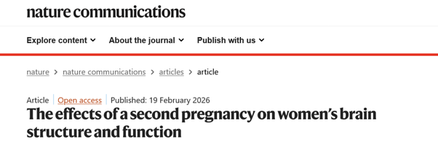
- A second pregnancy again changes the brain, but in a unique way
- Changes in the Default Mode Network are more pronounced in a first pregnancy, while changes in networks associated with attention and processing of somatosensory cues are more pronounced in a second pregnancy
- Pregnancy-related brain changes are associated with maternal mental health: changes in brain structure are linked to symptoms of peripartum depression in mothers across both a first and a second pregnancy
Exciting new results are expected soon!
We have recently completed several years of data collection for a large-scale prospective study and are currently analyzing these data. We have already encountered some very interesting results and will publish these in scientific journals. Key results will also be presented in our instagram @pregnancybrainlab.
Key publications
E. Hoekzema, E. Barba- Müller, C. Pozzobon, M. Picado, F. Lucco, D. García-García, J.C. Soliva, A. Tobeña, M. Desco, E.A. Crone, A. Ballesteros, S. Carmona, O. Vilarroya (2017). Pregnancy leads to long-lasting changes in human brain structure. Nature Neuroscience 20(2): 287-296.
S. Carmona, M. Martinez Garcia, M. Paternina Die, E. Barba- Müller, L.M. Wierenga, Y. Alemán-Gómez, C. Petrus, L. Marcos-Vidal, L. Beumala, R. Cortizo, C. Pozzobon, M. Picado, F. Lucco, D. García-García, J.C. Soliva, A. Tobeña, J.S. Peper, E.A. Crone, A. Ballesteros, M. Desco, O. Vilarroya, E. Hoekzema (2019). Pregnancy and adolescence entail similar neuroanatomical adaptations: A comparative analysis of cerebral morphometric changes. Human Brain Mapping 40(7):2143-2152.
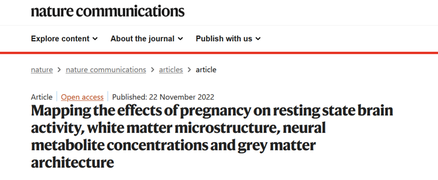
E. Hoekzema, H. van Steenbergen, M. Straathof, A. Beekmans, I.M. Freund, P.J.W. Pouwels, E.A. Crone (2022). Mapping the effects of pregnancy on resting state brain activity, white matter microstructure, neural metabolite concentrations and grey matter architecture. Nature Communications 13: 6931.
E. Hoekzema, C.K. Tamnes, P. Berns, E. Barba-Müller, C. Pozzobon, M. Picado, F. Lucco, M. Martínez-García, M. Desco, A. Ballesteros, E.A. Crone, O. Vilarroya, S. Carmona (2020). Becoming a mother entails anatomical changes in the ventral striatum of the human brain that facilitate its responsiveness to offspring cues. Psychoneuroendocrinology 112:104507.
E. Barba- Müller, S. Craddock, S. Carmona, E. Hoekzema, Brain plasticity in pregnancy and the postpartum period: Links to maternal caregiving and mental health (2019). Archives of Women’s Mental Health 22(2): 289-299.
M. Martínez-García, M. Paternina-Die, E. Barba-Müller, D. Martín de Blas, L. Beumala, R. Cortizo, C. Pozzobon, L. Marcos-Vidal, A. Fernández-Pena, M. Picado, E. Belmonte-Padilla, A. Massó-Rodriguez, A. Ballesteros, M. Desco, O. Vilarroya, E. Hoekzema, S. Carmona. Do Pregnancy-Induced Brain Changes Reverse? The Brain of a Mother Six Years after Parturition (2021). Brain Sciences 11(2):168.
K. Spalek, M. Straathof, L. Koyuncu, H,. Grydeland, A. van der Geest, S.R. van ;t Hof, E.A. Crone, E. Barba-Muller, S. Carmona, D. Denus, C.K. Tamnes, S. Burke, E. Hoekzema (2024). Pregnancy renders anatomical changes in hypothalamic substructures of the human brain that relate to aspects of maternal behavior. Psychoneuroendocrinology 164:107021.
S.R. van ‘t Hof, M. Straathof, K. Spalek, E. Hoekzema (2023). Theory of mind during pregnancy and postpartum: A systematic review. Journal of Neuroendocrinology 35(7): e13266.
J. Pawluski, E. Hoekzema, B. Leuker, J.S. Lonstein (2022). Less can be more: Fine tuning the maternal brain. Neuroscience Biobehavioral Reviews 133:104475.
The Paternal Transition Entails Neuroanatomic Adaptations that are Associated with the Father's Brain Response to his Infant Cues (2020). M. Paternina-Die, M. Martínez-García, C. Pretus, E. Hoekzema, E. Barba-Müller , D. Martín de Blas, C. Pozzobon, A. Ballesteros, O. Vilarroya, M. Desco, S. Carmona. Cerebral Cortex Communications 4:1(1).
S. Halmans, M. Straathof, E. Hoekzema (2025). Dynamic brain plasticity during the transition to motherhood. Trends in Cognitive Sciences 29(1):10-11.
S. Halmans, M. Straathof, D. Denys, E.A. Crone, K. Mansson, E. Hoekzema (2026). Pregnancy changes the variability of brain signaling. Neuroimage 333:121923.
S. Halmans, M. Straathof, S.R. van 't Hof, D. Denys, E.A. Crone, K. Mansson, E. Hoekzema (2026). Neural variability across the transition to motherhood: Enhanced moment-to-moment neural variability during mentalizing in first-time mothers. Journal of Neuroendocrinology 38(5):e70191.
M. Straathof, S. Halmans, P.J.W. Pouwels, E.A. Crone, E. Hoekzema (2026). The effects of a second pregnancy on women's brain structure and function. Nature Communications 17(1):1495.